Catégorie : Uncategorized

  • The ROI of Circularity: Beyond Compliance to Competitive Advantage

    The ROI of Circularity: Beyond Compliance to Competitive Advantage

    The circular economy has for too long been relegated to the domain of corporate social responsibility—a cost center driven by compliance and public relations. This perspective is now dangerously outdated. The circular economy is no longer a peripheral ESG issue; it is a powerful, data-backed driver of financial performance. By moving beyond the simplistic notion of recycling and adopting sophisticated circular business models, companies are unlocking substantial new revenue streams, achieving significant cost reductions, and building a lasting competitive advantage that will define the next generation of market leaders.

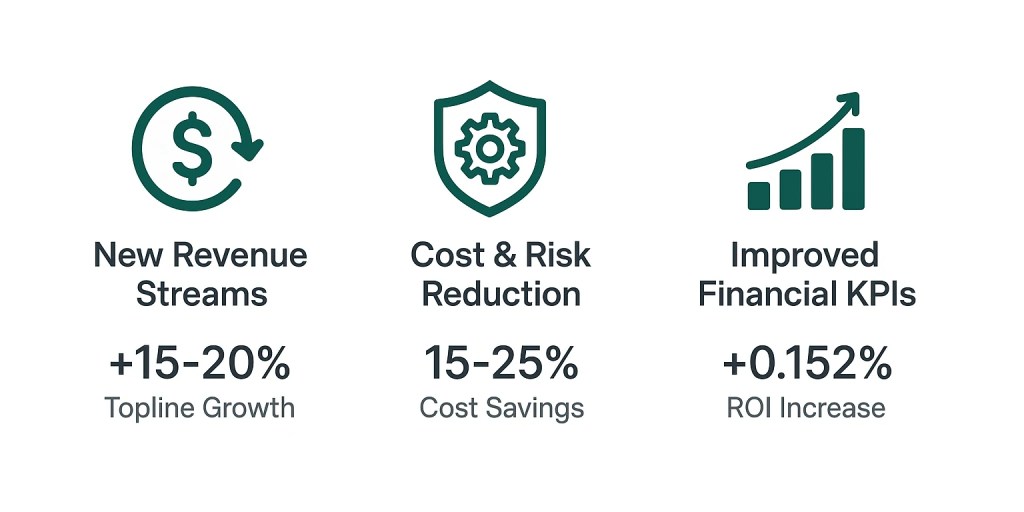
    Summary of the circular economy's financial benefits: New Revenue Streams (+15-20%), Cost & Risk Reduction (15-25%), and Improved Financial KPIs (+0.152% ROI).

    Revenue Generation: The New Growth Engine

    The circular economy offers a potent engine for growth by creating value from assets that were previously considered waste. Three models, in particular, have demonstrated remarkable success in generating new, high-margin revenue streams.

    1. Product-as-a-Service (PaaS): From One-Time Sale to Recurring Revenue

    The PaaS model shifts the focus from selling a product to selling an outcome or service, creating predictable, recurring revenue streams. This transformation has a profound impact on financial performance.

    • Microsoft Office 365 leads this transformation with a 17% year-over-year revenue growth.
    • Adobe Creative Cloud is another prime example, with 95% of its $21.5 billion revenue now from recurring sources, generating an Annual Recurring Revenue (ARR) of $17.2 billion.
    • This model is not limited to software. Rolls-Royce’s « Power by the Hour » model for jet engines now accounts for 65% of its revenue and has increased customer lifetime value by 35%.

    2. Brand-Owned Resale Platforms: Capturing the Secondary Market

    By taking control of their own second-hand market, brands can create a significant new revenue stream while enhancing customer loyalty.

    • Brand-owned resale platforms have generated a collective $4.2 billion in new revenue across major consumer brands.
    • Apple’s Trade-In program dominates this space, creating a $2.8 billion annual revenue stream and increasing customer lifetime value by 40%.
    • Nike Refurbished has also proven the model’s viability, generating $420 million in new revenue and improving customer lifetime value by 48%.

    3. Remanufacturing: Unlocking Value from End-of-Life Products

    Remanufacturing allows companies to reclaim valuable components from used products and sell them as « same-as-new, » often at a much higher profit margin.

    • Industry research consistently shows that remanufactured parts deliver profit margins of approximately 20%, compared to just 3-8% for new parts. This represents a 2.5x to 6.7x improvement in profitability.
    • Industrial giants like Caterpillar, the world’s leading remanufacturer of diesel engines, offer their « Cat Reman » products at up to 60% lower cost than new products, backed by the same warranty, contributing to the company’s industry-leading 20.17% operating margin.

    Cost Reduction and Risk Mitigation: Building a More Resilient Enterprise

    Beyond generating new revenue, circular practices are a powerful tool for reducing operational costs and de-risking supply chains.

    1. Design for Disassembly (DfD): Engineering Out the Costs

    By designing products for easy disassembly, companies can dramatically reduce the cost and effort required for repair, refurbishment, and remanufacturing.

    • In the automotive sector, DfD can yield cost savings of 15-25% and cut disassembly labor time by up to 40%.
    • For electronics, modular designs can reduce labor time by 30-45% and overall remanufacturing costs by 12-20%.
    • These savings are not just theoretical; a 2023 study on automotive electronics found that DfD cut total remanufacturing costs by 22%.

    2. Recycled Materials: A Hedge Against Volatility

    Incorporating recycled materials into the supply chain reduces dependence on virgin raw materials, providing a powerful buffer against price volatility and geopolitical disruptions.

    • The price of key battery metals like lithium dropped nearly 70% from its peak between 2022 and 2024, creating massive uncertainty for manufacturers. Academic studies from 2023 show that firms using recycled lithium and cobalt experienced less procurement cost volatility as recycled material prices proved more stable.
    • The geographic concentration of critical minerals—with China controlling 34% of rare earths and the DRC 48% of cobalt—exposes supply chains to significant geopolitical risk. A robust recycled material supply chain helps to regionalize sourcing and reduce this dependency.

    Impact on Key Financial KPIs: The Quantifiable Advantage

    The strategic benefits of circularity translate directly into measurable improvements in core financial metrics.

    • A 2024 study of 200 European manufacturing companies found that each one-point increase in a company’s Circular Economy Index was associated with a +0.152 percentage point increase in ROI and a +0.087 percentage point increase in Gross Profit Margin.
    • Consulting firms have quantified the broader opportunity. BCG reports that circular models can deliver 15-20% topline growth and 10-15% material cost savings. Accenture projects a $4.5 trillion global growth opportunity by 2030.
    • Circular models also have a direct impact on customer value metrics. Brand-owned resale programs have been shown to reduce customer acquisition costs by an average of 28.8% while increasing customer lifetime value by 48.8%.

    Conclusion & Outlook: The New Competitive Imperative

    The data is unequivocal: the circular economy is no longer a matter of corporate conscience, but of competitive necessity. The companies that are winning in the market—from industrial giants like Rolls-Royce and Caterpillar to technology leaders like Microsoft and Apple—are those that have embraced circularity as a core driver of their business strategy. They are leveraging these models to create predictable revenue streams, reduce operational costs, de-risk their supply chains, and build deeper relationships with their customers.

    For C-level executives and investors, the message is clear. The transition to a circular economy is not a trend; it is a fundamental economic shift. The question is no longer if your company should adopt circular models, but how quickly you can do so to secure a competitive advantage in the intelligent, resource-efficient economy of the future.

    Conceptual image of sustainable growth, showing a rising bar chart next to a green leaf, representing financial ROI in the circular economy.
  • Beyond Recycling: The Three Core Technologies Driving the True Circular Economy

    Beyond Recycling: The Three Core Technologies Driving the True Circular Economy

    For decades, the concept of a circular economy has been almost singularly focused on recycling. While well-intentioned, this narrow view has created an illusion of progress, masking a system that remains fundamentally linear. Recycling, in its current form, is often inefficient, energy-intensive, and results in downcycled materials of lower quality. The true revolution in the circular economy is not about better recycling bins; it is about building a new technological infrastructure from the ground up. This revolution is being driven by three core, interconnected technologies—Digital Product Passports, AI in Material Sorting, and Advanced Materials Science—that are transforming products from future waste into perpetually renewable assets.

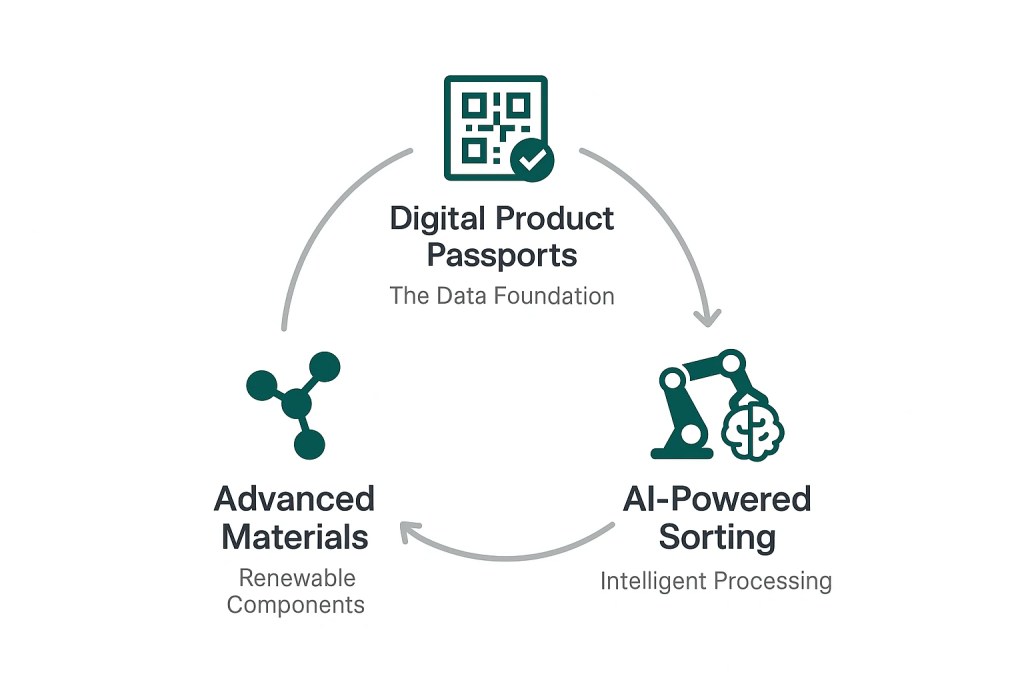
    An infographic illustrating the three core technologies of the circular economy: Digital Product Passports (the data foundation), AI-Powered Sorting (intelligent processing), and Advanced Materials (renewable components).

    Digital Product Passports: Creating a Data-Driven Lifecycle

    The foundation of a true circular economy is data. Without knowing a product’s precise material composition, origin, and end-of-life instructions, circularity is impossible. The European Union’s Digital Product Passport (DPP) initiative is the single most important regulatory driver forcing this transparency into existence. Legally enshrined under the Ecodesign for Sustainable Products Regulation (ESPR), the DPP mandates a comprehensive electronic record for products, making lifecycle data accessible to consumers, recyclers, and regulators.

    The rollout is aggressive and already underway. Following the adoption of the first working plan in April 2025, the textile industry will be the first major sector to comply, with DPPs becoming mandatory by July 2027. This means every garment sold in the EU will have a scannable QR code linking to its passport, detailing material composition, supply chain origins, carbon footprint, and specific repair and recycling instructions.

    Industry leaders are not waiting. Fashion brands Kappahl and Marimekko have already launched pilots, equipping over 3,000 products with DPPs. In the automotive sector, Porsche and BASF are collaborating on a blockchain-enabled DPP to track plastics, while Ford and Everledger have pioneered a battery passport to manage the lifecycle of EV batteries. These passports are not just static labels; they are dynamic, often secured by blockchain for data integrity, and designed to provide the granular intelligence needed for a circular system to function at scale. The global DPP market is projected to explode from $185.9 million in 2024 to $1.78 billion by 2030, a clear signal of its foundational importance.

    AI-Powered Sorting: Intelligent Eyes for a Complex World

    Once a product reaches its end-of-life, the challenge shifts to accurately and efficiently sorting its components. Human sorting is slow, costly, and error-prone, a primary reason why billions of dollars in valuable materials end up in landfills. AI-powered robotics and computer vision are solving this problem with superhuman speed and precision.

    Companies at the forefront of this space are achieving staggering results. AMP Robotics, a leader in municipal solid waste, has deployed over 400 AI systems that have identified 150 billion items to date, achieving over 90% recovery rates in facilities with near-zero manual sorting. For heavy-duty construction and demolition waste, ZenRobotics’ fourth-generation Heavy Picker can make up to 9,200 picks per hour, a 60-100% efficiency increase over previous systems.

    These are not simple machines; they are sophisticated learning systems. Greyparrot, a global leader in AI waste analytics, has analyzed over 40 billion waste objects in 2024 alone, using this data to continuously train its models. The technology can identify over 30 material types, from specific polymer grades to different types of aluminum, with up to 99% accuracy. The impact is transformative, turning contaminated waste streams into clean, valuable commodities. Companies like Glacier, backed by Amazon’s Climate Pledge Fund, are making this technology more accessible, offering compact, affordable robots that can identify $900,000 in annual revenue opportunities for a single facility by diverting valuable materials from landfills.

    Advanced Materials Science: Designing for Infinity

    The final and most visionary piece of the circular puzzle is the innovation happening at the molecular level. Advanced materials science is creating a new generation of polymers and composites designed for infinite reuse without quality degradation.

    Chemical Recycling Breakthroughs

    The most significant recent breakthroughs are in chemical recycling. In 2024, the development of Chemical Recycling to All Rings (CRR) technology demonstrated the ability to achieve true closed-loop recycling for polymers previously considered unrecyclable. At the same time, new polydiketoenamines (PDKs) can now be completely depolymerized back to their base monomers at room temperature, creating virgin-quality material with minimal energy input.

    The Rise of Biodegradable Polymers

    Beyond plastics, the field of biodegradable polymers is making significant strides. Innovations in 2024-2025 include:

    • Marine-Biodegradable Polymers: Addressing the ocean plastics crisis, new materials derived from cacao by-products and bamboo are being developed to fully biodegrade in marine environments.
    • Thermodynamically Reversible Polymers: Scientists have created cyclic polyesters that can be chemically « unzipped » and « re-zipped » repeatedly, enabling infinite recycling with no loss of performance.

    These are not niche laboratory experiments; the global bioplastics market is on track to reach nearly $28 billion by 2025, driven by these very innovations.

    Implications for Business: From Linear to Intelligent

    The convergence of these three technologies necessitates a fundamental rethinking of corporate strategy:

    • Product Design: Products must be designed for disassembly and data. The DPP will force designers to consider a product’s entire lifecycle from day one, embedding intelligence and traceability into its very core.
    • Supply Chain Management: The demand for transparent, verifiable data will require unprecedented collaboration across supply chains. Companies will need to invest in the systems and partnerships required to track materials from source to end-of-life.
    • Corporate Strategy: The business model of the future is not selling a product, but managing an asset. Companies that leverage these technologies will be able to create new revenue streams from repair, remanufacturing, and high-quality material recovery.

    Conclusion & Outlook: The Intelligent Circular Economy

    For too long, the circular economy has been a simplified ideal, hampered by a lack of data, inefficient processes, and materials never designed for reuse. The technologies of the next industrial revolution are finally providing the tools to build a true circular system. Digital Product Passports create the data foundation, AI-powered sorting provides the intelligent processing, and advanced materials science delivers the infinitely renewable components.

    The future is not just a linear economy made slightly less wasteful through recycling. It is a deeply integrated, intelligent, and technologically-enabled circular economy, where the concept of « waste » itself becomes obsolete.