
The circular economy has for too long been relegated to the domain of corporate social responsibility—a cost center driven by compliance and public relations. This perspective is now dangerously outdated. The circular economy is no longer a peripheral ESG issue; it is a powerful, data-backed driver of financial performance. By moving beyond the simplistic notion of recycling and adopting sophisticated circular business models, companies are unlocking substantial new revenue streams, achieving significant cost reductions, and building a lasting competitive advantage that will define the next generation of market leaders.
Revenue Generation: The New Growth Engine
The circular economy offers a potent engine for growth by creating value from assets that were previously considered waste. Three models, in particular, have demonstrated remarkable success in generating new, high-margin revenue streams.
1. Product-as-a-Service (PaaS): From One-Time Sale to Recurring Revenue
The PaaS model shifts the focus from selling a product to selling an outcome or service, creating predictable, recurring revenue streams. This transformation has a profound impact on financial performance.
- Microsoft Office 365 leads this transformation with a 17% year-over-year revenue growth.
- Adobe Creative Cloud is another prime example, with 95% of its $21.5 billion revenue now from recurring sources, generating an Annual Recurring Revenue (ARR) of $17.2 billion.
- This model is not limited to software. Rolls-Royce’s « Power by the Hour » model for jet engines now accounts for 65% of its revenue and has increased customer lifetime value by 35%.
2. Brand-Owned Resale Platforms: Capturing the Secondary Market
By taking control of their own second-hand market, brands can create a significant new revenue stream while enhancing customer loyalty.
- Brand-owned resale platforms have generated a collective $4.2 billion in new revenue across major consumer brands.
- Apple’s Trade-In program dominates this space, creating a $2.8 billion annual revenue stream and increasing customer lifetime value by 40%.
- Nike Refurbished has also proven the model’s viability, generating $420 million in new revenue and improving customer lifetime value by 48%.
3. Remanufacturing: Unlocking Value from End-of-Life Products
Remanufacturing allows companies to reclaim valuable components from used products and sell them as « same-as-new, » often at a much higher profit margin.
- Industry research consistently shows that remanufactured parts deliver profit margins of approximately 20%, compared to just 3-8% for new parts. This represents a 2.5x to 6.7x improvement in profitability.
- Industrial giants like Caterpillar, the world’s leading remanufacturer of diesel engines, offer their « Cat Reman » products at up to 60% lower cost than new products, backed by the same warranty, contributing to the company’s industry-leading 20.17% operating margin.
Cost Reduction and Risk Mitigation: Building a More Resilient Enterprise
Beyond generating new revenue, circular practices are a powerful tool for reducing operational costs and de-risking supply chains.
1. Design for Disassembly (DfD): Engineering Out the Costs
By designing products for easy disassembly, companies can dramatically reduce the cost and effort required for repair, refurbishment, and remanufacturing.
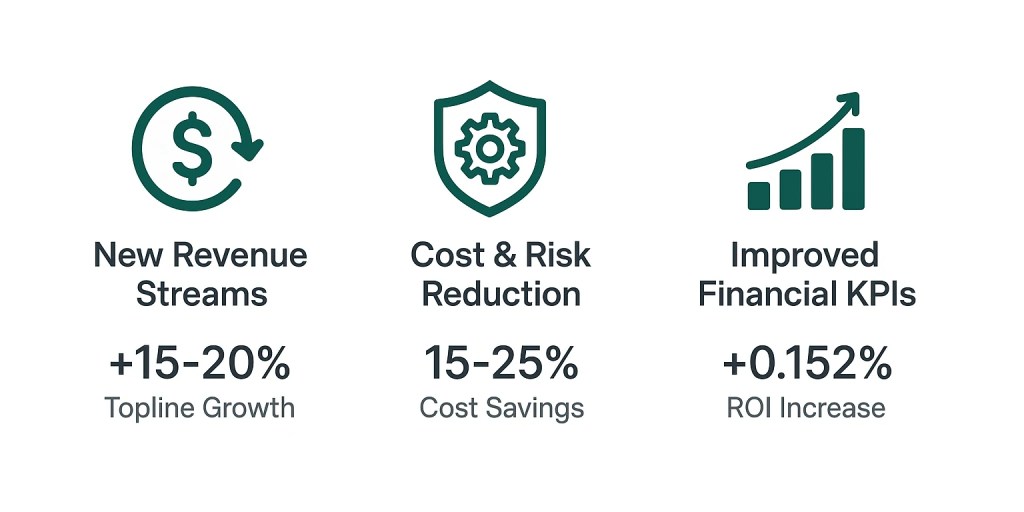
- In the automotive sector, DfD can yield cost savings of 15-25% and cut disassembly labor time by up to 40%.
- For electronics, modular designs can reduce labor time by 30-45% and overall remanufacturing costs by 12-20%.
- These savings are not just theoretical; a 2023 study on automotive electronics found that DfD cut total remanufacturing costs by 22%.
2. Recycled Materials: A Hedge Against Volatility
Incorporating recycled materials into the supply chain reduces dependence on virgin raw materials, providing a powerful buffer against price volatility and geopolitical disruptions.
- The price of key battery metals like lithium dropped nearly 70% from its peak between 2022 and 2024, creating massive uncertainty for manufacturers. Academic studies from 2023 show that firms using recycled lithium and cobalt experienced less procurement cost volatility as recycled material prices proved more stable.
- The geographic concentration of critical minerals—with China controlling 34% of rare earths and the DRC 48% of cobalt—exposes supply chains to significant geopolitical risk. A robust recycled material supply chain helps to regionalize sourcing and reduce this dependency.
Impact on Key Financial KPIs: The Quantifiable Advantage
The strategic benefits of circularity translate directly into measurable improvements in core financial metrics.
- A 2024 study of 200 European manufacturing companies found that each one-point increase in a company’s Circular Economy Index was associated with a +0.152 percentage point increase in ROI and a +0.087 percentage point increase in Gross Profit Margin.
- Consulting firms have quantified the broader opportunity. BCG reports that circular models can deliver 15-20% topline growth and 10-15% material cost savings. Accenture projects a $4.5 trillion global growth opportunity by 2030.
- Circular models also have a direct impact on customer value metrics. Brand-owned resale programs have been shown to reduce customer acquisition costs by an average of 28.8% while increasing customer lifetime value by 48.8%.
Conclusion & Outlook: The New Competitive Imperative
The data is unequivocal: the circular economy is no longer a matter of corporate conscience, but of competitive necessity. The companies that are winning in the market—from industrial giants like Rolls-Royce and Caterpillar to technology leaders like Microsoft and Apple—are those that have embraced circularity as a core driver of their business strategy. They are leveraging these models to create predictable revenue streams, reduce operational costs, de-risk their supply chains, and build deeper relationships with their customers.
For C-level executives and investors, the message is clear. The transition to a circular economy is not a trend; it is a fundamental economic shift. The question is no longer if your company should adopt circular models, but how quickly you can do so to secure a competitive advantage in the intelligent, resource-efficient economy of the future.

 Circular Pro Tech
Laisser un commentaire